The Millbrook Ledger
Features
150 Years In, the Millbrook County Fair Still Smells Like Funnel Cake and Diesel
This year's Castellan County Fair marked its sesquicentennial. A look back at how a Civil War-era livestock show became the week half the county still plans its summer around.
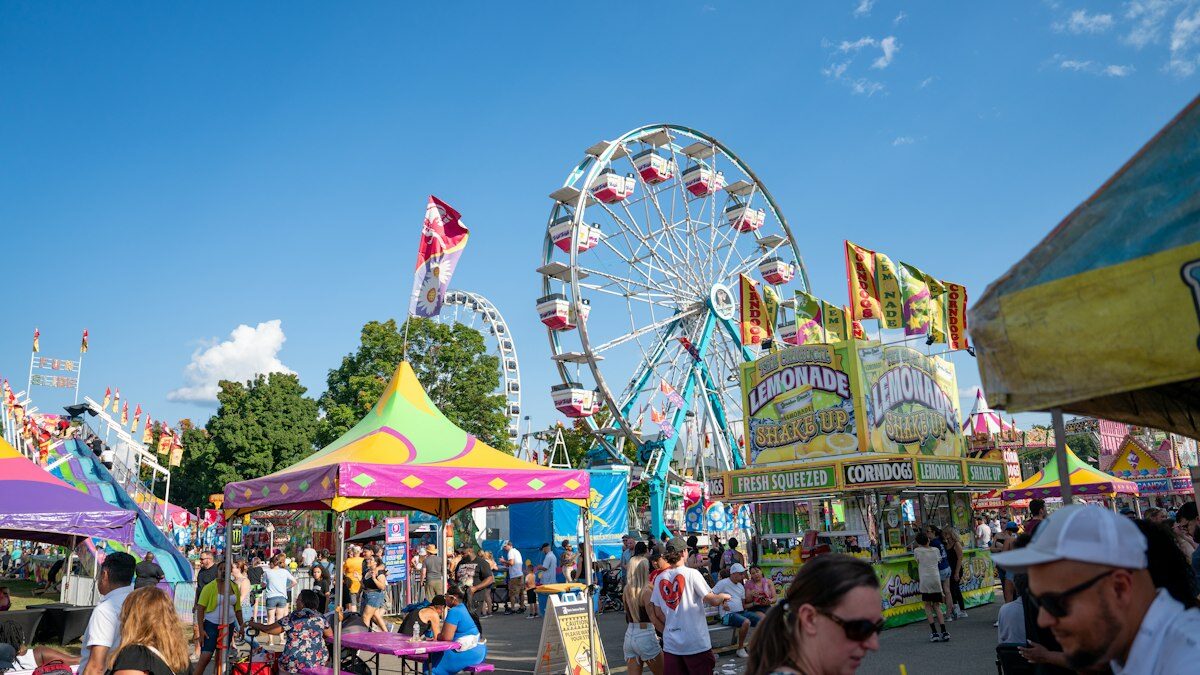
MILLBROOK, Ind. — The Castellan County Fair turned 150 this year, and if you ask Opal Fenwick, who has volunteered at the dairy barn since 1968, it has not changed nearly as much as most of the county has around it. “The cows still don’t want to be judged at eight in the morning,” she said, leaning on a stall gate during the fair’s final day in September. “Some things are permanent.”
The fair’s first recorded run was in the fall of 1876, organized by a group of local farmers as the Castellan County Agricultural Society’s annual livestock and produce exhibition, held on a 14-acre plot donated by a founding family whose descendants, the Castellanos family, still farm land a few miles from the current fairgrounds. This year’s sesquicentennial fair drew an estimated 61,000 visitors over its six-day run in September, according to fair board figures, the highest attendance on record.
“We have the 1876 ledger book in the historical society’s archive,” said county historian Benedict Okafor-Hale, who helped curate a small sesquicentennial exhibit in the fair’s administration building this year. “It’s mostly a list of prize winners for best hog and best preserved fruit. The handwriting is better than mine. Otherwise it’s not that different from this year’s program, honestly.”
What a Fair Looked Like in 1876
The earliest fairs were almost entirely agricultural: livestock judging, crop exhibitions, and a women’s domestic arts competition for preserves, quilts, and baked goods that, in a direct if much-expanded line, still exists today as the fair’s open-class exhibit hall. There was no midway, no carnival rides, and no admission gate in the earliest years — the fair ran on exhibitor entry fees and a modest subscription from county farmers who treated it as a working showcase for breeding stock and seed, not an entertainment event.
That started to change around the turn of the century, when the fair added its first horse-racing track in 1903 and its first mechanical amusement ride, a steam-powered carousel, in 1911. By the 1920s, according to records in the historical society’s archive, the fair had become enough of a social event that local churches began running food booths specifically to fund building projects, a tradition several Millbrook congregations continue to this day.
Surviving the Lean Years
The fair nearly didn’t survive the Great Depression; fair board minutes from 1932 and 1933, also preserved in the historical society archive, show the board debating whether to cancel the fair outright for lack of funds before ultimately running a scaled-down, three-day version in both years, funded partly out of board members’ own pockets. A longer gap came during the Second World War, when the fair paused entirely from 1943 to 1945 as gasoline rationing made travel to the fairgrounds impractical for most farm families.
“That three-year gap is the only real interruption in 150 years,” Okafor-Hale said. “Everything else — recessions, a couple of genuinely bad harvest years, at least one year with a measles outbreak that cut attendance way down — the fair just kept running through it. That’s part of why I think people treat it as more than entertainment. It’s one of the few things in this county that has shown up every year since 1946 without fail.”
The Modern Fair
Today’s six-day fair bears only a loose resemblance to its 1876 ancestor, with a midway carnival contracted through a traveling ride operator, a grandstand concert series that has drawn regional country acts for three decades, and a demolition derby that fair board president Connie Albrecht-Suh said is now the single best-attended event of the week, outdrawing even the Saturday night concert in most recent years. The livestock judging and 4-H exhibits that founded the fair in 1876 still run every morning, largely unchanged in format, just considerably smaller as a share of total attendance than they were a century ago.
- The fair's first run was in 1876 on a 14-acre donated plot; the current fairgrounds have grown to 86 acres.
- Its only extended interruption came from 1943 to 1945, during World War II gasoline rationing.
- This year's sesquicentennial fair drew an estimated 61,000 visitors, the highest on record.
- The open-class exhibit hall traces directly back to the original 1876 domestic arts competition.
What 4-H Families Say It Means
For families still showing livestock, the fair’s continuity across 150 years is less a historical curiosity than a lived family tradition. The Pruitt family of rural Castellan County has shown dairy cattle at the fair for five consecutive generations, dating to a great-great-grandfather who exhibited in the 1920s. “My daughter showed her heifer in the same ring my grandmother showed in,” said Darlene Pruitt, standing near the dairy barn during this year’s judging. “That’s not something you get to say about most things anymore.”
Looking Toward 200
Fair board members say they have no plans to dramatically reinvent the event for its next half-century, even as attendance patterns shift and the agricultural exhibits that founded it represent a shrinking share of the county’s economy. “We added air conditioning to the exhibit hall in 2019 and some people still complain it ruins the atmosphere,” Albrecht-Suh said, laughing. “I think that tells you how much room there is to change this thing without it stopping being what it is. We’re planning the 150th, not reinventing the fair. There’s a difference.”
Fenwick, back at the dairy barn gate, put it more simply when asked what she hoped the fair would look like at its 200th anniversary, in 2076. “Cows, kids showing cows, somebody’s grandmother winning best peach preserves, and a line for fried something,” she said. “If that’s still true, we did it right.”